
BIM-Driven Corridor Modeling: Classification Principles from Sweden, Denmark and Finland
SIA "Madaberi" analyzed the civil engineering coding principles used in Sweden, Denmark, and Finland to evaluate which system would best support our future development.
6/24/20245 min read

The Swedish coding system in civil engineering generally refers to structured classification systems used to organize, describe, and standardize construction works, building components, and infrastructure projects in Sweden. These systems are widely used in design, procurement, cost estimation, BIM, and facility management.
The most important coding system in Swedish civil engineering is BSAB. Example structure
A - Main category (e.g., Ground, Structure, Installations);
AB - Subcategory;
ABC - More detailed level;
ABC.1 - Even more detailed classification.
The systems exist to:
Standardize communication;
Support BIM and digital workflows;
Reduce ambiguity in contract;
Enable structured cost calculation.
Swedish systems align with:
ISO 12006-2 (Construction classification framework);
IFC (BIM data structures);
European construction standards.
The Swedish coding systems (mainly BSAB, CoClass, and AMA) provide major structural, economic, and digital advantages in civil engineering projects. Their benefits go far beyond simple labeling — they form the backbone of how projects are designed, procured, built, and managed in Sweden.
Reduces misunderstandings
Standardized communication reduces misunderstandings by giving every component and system a clear, consistent code, so all stakeholders use the same technical language and minimize errors in project documentation.
Clear Contract Documentation (AMA Integration)
By integrating Swedish coding systems with AMA, each code links to predefined technical requirements, reducing specification work, minimizing disputes, and improving clarity, transparency, and risk management in contracts.
Better Cost Estimation & Budget Control
The hierarchical coding structure allows quantities to be grouped by work type, cost databases to link directly to codes, and historical data to be reused—resulting in more accurate estimates, easier project comparisons, stronger cost control, and more efficient change management, which is especially valuable in infrastructure projects.
Reduced Risk & Legal Protection
Clear coding combined with AMA specifications reduces disputes by ensuring clear scope definitions, better traceability of responsibilities, and a stronger audit trail—making it especially valuable in large public procurements.
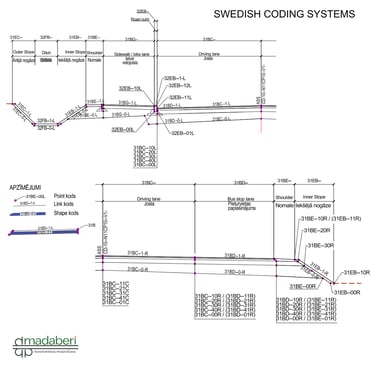
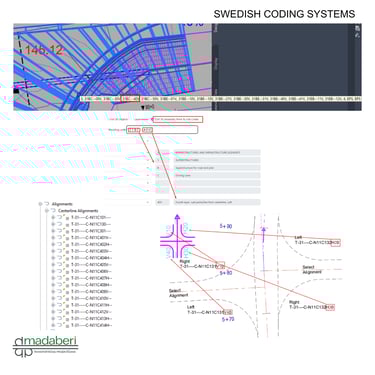
Swedish coding systems
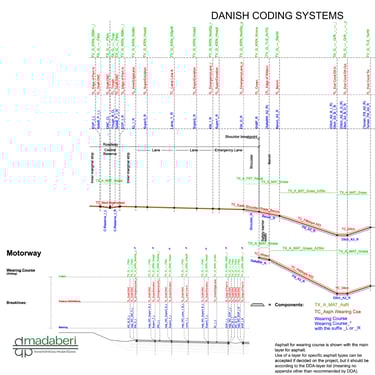
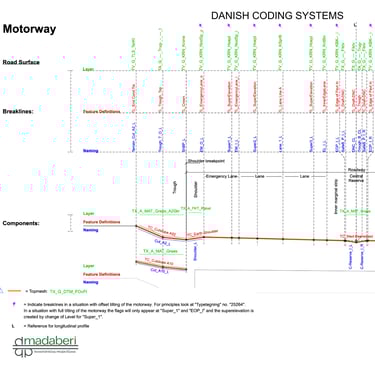
Danish coding systems
The Danish coding system is a structured, object-based naming method used in digital road design and BIM/CAD. It standardizes how road elements are named, keeps disciplines clearly separated, supports automation in 3D and terrain models, enables collaboration between stakeholders, and ensures consistent data throughout the asset lifecycle. It combines classification, function, location, and status directly within object names.
Codes follow a structured multi-part logic such as:
AC_Super1_B_L;
BaC_T_O_R;
TL_Draft-DNC;
TX_G_DTM_Baerl.
Each part of the code carries specific meaning:
AC - Asphalt Concrete;
BaC - Base Course;
TL - Terrain Layer;
TX - Terrain / Model exchange;
EM - Earthworks model.
What kind of construction element is being modeled:
T - Top;
B - Bottom;
O - Outer;
I – Inner;
EM - Earth Model.
This is crucial in Danish road modeling because all objects are modeled relative to a centerline, with left/right logic enabling automatic section generation.
Layer-Based Modeling
Each pavement structure is modeled as distinct structural layers, with separate top and bottom surfaces and clear left/right separation. This enables accurate quantity takeoff, reliable machine control data generation, and clear BIM object separation.
Surface-Based Geometry
Instead of modeling volumes directly, the system models surfaces (top, bottom, inner, outer), from which volumes are derived. This improves clash detection, earthwork calculations, and cross-section automation.
Machine-Readable Logic
The naming structure is not only human-readable but also designed for automation, supporting model export, IFC mapping, road corridor generation, and digital construction workflows.
The Danish coding system in civil engineering enhances clarity, standardization, and automation by systematically defining geometric elements and structural layers, thereby improving interoperability, accuracy in quantity calculations, and lifecycle data management.
Better 3D Modeling and BIM Integration
Each structural layer—such as asphalt, base, and earthworks—is modeled as an individual object, creating a structured BIM model instead of a simple CAD drawing, which improves calculation accuracy, clash control, data exchange, and digital delivery quality.
Improved Quantity Take-Off
By separating surfaces (top, bottom, left, and right), volumes and layer thicknesses can be calculated automatically, improving earthwork accuracy, reducing cost estimation risks, speeding up BOQ generation, and increasing pricing transparency.
Risk Reduction
Clear coding prevents misinterpretation between consultants and contractors, avoids layer and surface confusion, and reduces left–right carriageway errors, significantly lowering construction risk in complex motorway corridors.
Finnish coding systems
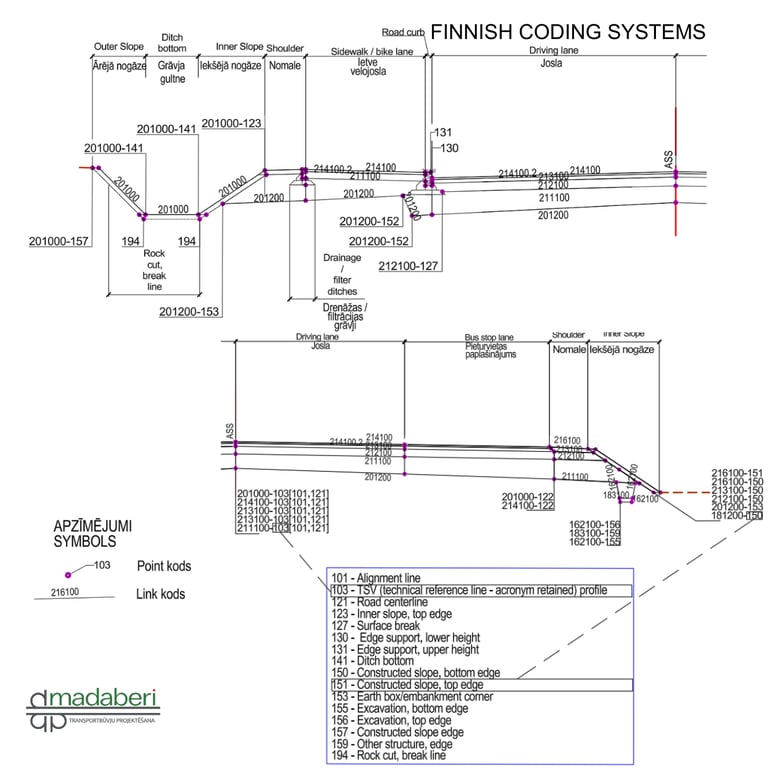
Finland uses a standardized infrastructure classification system called: InfraBIM Nimikkeistö (InfraBIM Classification System). It is developed under buildingSMART Finland and based on the broader Finnish infrastructure classification tradition (RO-nimikkeistö).
It provides:
A numeric code system;
A hierarchical structure;
Standardized naming (Finnish + English);
Consistent classification for BIM, design, construction, and asset management.
The system is hierarchical and numeric, meaning. Larger number groups represent broad categories. Additional digits define more specific subcategories.-
1000 (Main category) - Soil, substructures and rock structures;
1100 (Subcategory) - Existing structures and construction parts;
110000 - More specific subdivision under 1100.
Each additional digit refines the object definition, creating a clear structure that allows unlimited expansion and precise classification within BIM models.
We looked at two main areas of coding:
- Pintakoodaus (Surface Coding)
Surface coding classifies terrain, structural, pavement, and earthwork surfaces in InfraBIM so that each modeled surface—such as subgrade, asphalt, or excavation—has a specific code, allowing software and machines to interpret them correctly.
- Tärke- ja toteumamittauskoodit (Stake-out and As-built Measurement Codes)
These codes are used for surveying, construction layout, as-built verification, and field measurements, ensuring consistent classification of measurement points, alignment between survey and design data, and correct reading by construction control systems.
Key Characteristics of the Finnish System
The Finnish system is hierarchical with a clear parent–child structure, numeric and machine-readable, designed for infrastructure BIM (InfraBIM), nationally standardized across road, rail, municipal, and utility projects, and compatible with IFC and openBIM workflows.
Building on this standardization, InfraBIM codes enable true BIM for infrastructure by giving every modeled object a clear identity, defined function, and standardized classification, which supports software interoperability, IFC/openBIM data exchange, and fully model-based workflows instead of relying on 2D drawings.
Supports Machine Control & Automation
In Finland’s highly advanced machine-controlled construction environment, the coding system enables accurate surface identification, automated equipment reading, reduced human error, and precise grading and layer construction, improving on-site productivity and accuracy.
Accurate Quantity Takeoffs
Because every object has a defined code:
Quantities can be calculated automatically;
Bills of quantities are consistent;
Cost estimation becomes more reliable;
Risk of double-counting is reduced;
This improves financial control in infrastructure projects.
Reduces Errors and Rework
Because elements are clearly classified, misunderstandings are minimized, manual interpretation is reduced, documentation errors decrease, and the risk of costly rework is lowered, increasing overall reliability through standardization.
National Competitive Advantage
Finland’s unified coding system supports advanced digital construction, high BIM maturity, strong machine-control integration, and efficient infrastructure delivery, strengthening the country’s position in digital civil engineering.
Swedish Strengths in Coding Systems:
+ Clearly defined cross-sectional elements with assigned functional meaning and precise vertical and horizontal positioning.
+ BIM models enable filtering and structuring of elements by functional role (e.g., carriageway, sidewalk, shoulder) using standardized alphanumeric codes.
+ Consistent code structure and uniform character length ensure machine readability, automated data processing, and support for digital workflows and machine learning applications.
Danish Strengths in Coding Systems:
+ Points, surfaces, and shapes are clearly defined, and standardized letter abbreviations are used within the coding system.
Danish Limitations in Coding Systems:
- The number of characters in element name codes varies, which increases complexity and may reduce readability.
- Cross-sectional elements are not explicitly defined according to their functional significance.
Finnish strengths in Coding Systems:
+ Clearly defined points and surfaces (Point codes and Surface codes).
+ Coding principles based on numeric structure.
+ Equal number of digits within code groups, enabling efficient machine readability and automated data processing.
Finnish limitations in Coding Systems:
- Lack of dedicated shape coding.
- Limited definition of vertical and horizontal positioning.
- The coding structure does not specify the spatial location of points or lines.
Our analysis shows that modern coding systems are no longer just naming conventions — they shape how infrastructure is modeled, automated, and managed.
The key is building a structured, machine-readable, and functionally meaningful framework that supports BIM, automation, and long-term digital workflows.
Sources:
https://coclass.byggtjanst.se/login
https://digitalvej.vejdirektoratet.dk/sektion/ms-corridor-roads-and-paths
https://wiki.buildingsmart.fi/fi/04_Julkaisut_ja_Standardit/infrabim_nimikkeisto
https://drive.buildingsmart.fi/s/GTP9RdyMH9DqibR?dir=/&editing=false&openfile=true
Summary of Coding Systems
Contacts
Follow us
INFO
SIA ''Madaberi''
rEG.NR.: 40203553045
PVN REG.NR.: LV40203553045
Smiltenes nov., Smiltene, Raiņa iela 9A-2, LV-4729
banka: AS "SEB banka"
swift: UNLALV2X
konta nr.: LV08UNLA0055001589494
info@madaberi.lv
© 2025. All rights reserved.
In cooperation with SIA “Vārpiņas MR”